
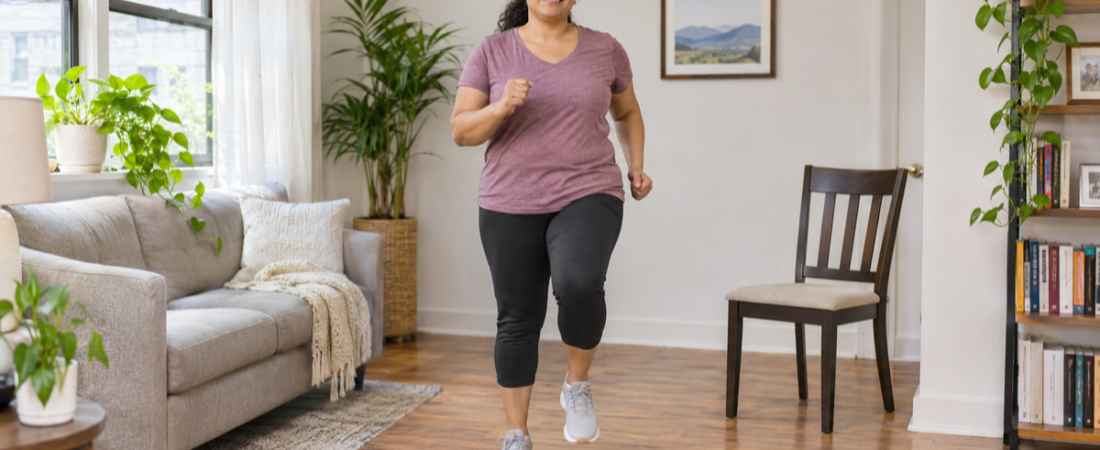
By Weight Loss Survival Editorial Team · Updated November 28, 2026 · How we review content
Health note: This routine provides general education for adults, not medical advice. Stop if you develop chest pain, faintness, severe or unusual shortness of breath, or another alarming symptom. Ask a qualified health professional for personal activity guidance if you have a health condition, injury, balance concern, are pregnant, or take medication that affects your response to exercise.
You do not need a treadmill, a large room, or a full hour to begin moving more. This 10-minute indoor walking workout combines easy marching, side steps, heel taps, and a gradual cool-down. It is designed for beginners who want a simple session they can perform in a small indoor space without jumping.
Ten minutes is not a magic weight-loss dose, and one workout cannot predict a change on the scale. It can, however, be a realistic building block. The CDC says adults can spread physical activity across the week and break it into smaller chunks. Your long-term aim may be the general guideline of 150 minutes of moderate-intensity aerobic activity per week, but starting below that level and building gradually is appropriate when you are new to activity.
What this 10-minute indoor workout is designed to do
The routine helps you practice continuous low-impact movement, find a manageable effort, and learn which movements feel comfortable in your space. It may also help interrupt a long period of sitting. The goal for your first session is not to finish exhausted; it is to finish knowing you could repeat the routine another day.
- Space: roughly enough room to take one step forward, backward, and sideways.
- Equipment: none. A sturdy chair can provide optional balance support.
- Impact: low; one foot can remain on or close to the floor throughout.
- Effort: easy to moderate for you. Effort is individual, so the same pace may feel different to different people.
- Best use: a standalone movement break, a beginner session, or one of several short activity periods during the day.
Before you begin: make the room safer
Walk through the area before starting. Move cords, loose rugs, bags, toys, and low tables out of your path. Wear shoes that feel stable on your floor, or use another footwear choice recommended for your needs. Place a sturdy chair near you if touching the back lightly would improve balance. Do not use a rolling, folding, or unstable chair for support.
Keep water available if the room is warm or you know you will want it. If standing continuously is not comfortable, use the seated version below or alternate between standing and sitting. A shorter safe session is more useful than forcing ten minutes with worsening pain or poor balance.
How hard should an indoor walking workout feel?
Use breathing and conversation rather than a calorie display to judge effort. At a moderate effort, the CDC describes breathing and heart rate as noticeably higher; the talk test is a practical cue. For this beginner routine, you should generally still be able to speak in sentences. Slow down if you cannot control the movement or if talking becomes unexpectedly difficult.
Begin the first two minutes at an intentionally easy pace. If the session feels good, let the middle minutes become slightly more purposeful while keeping the steps controlled. The final minute should feel easier again. There is no required step count, knee height, arm speed, or distance.
The 10-minute indoor walking workout
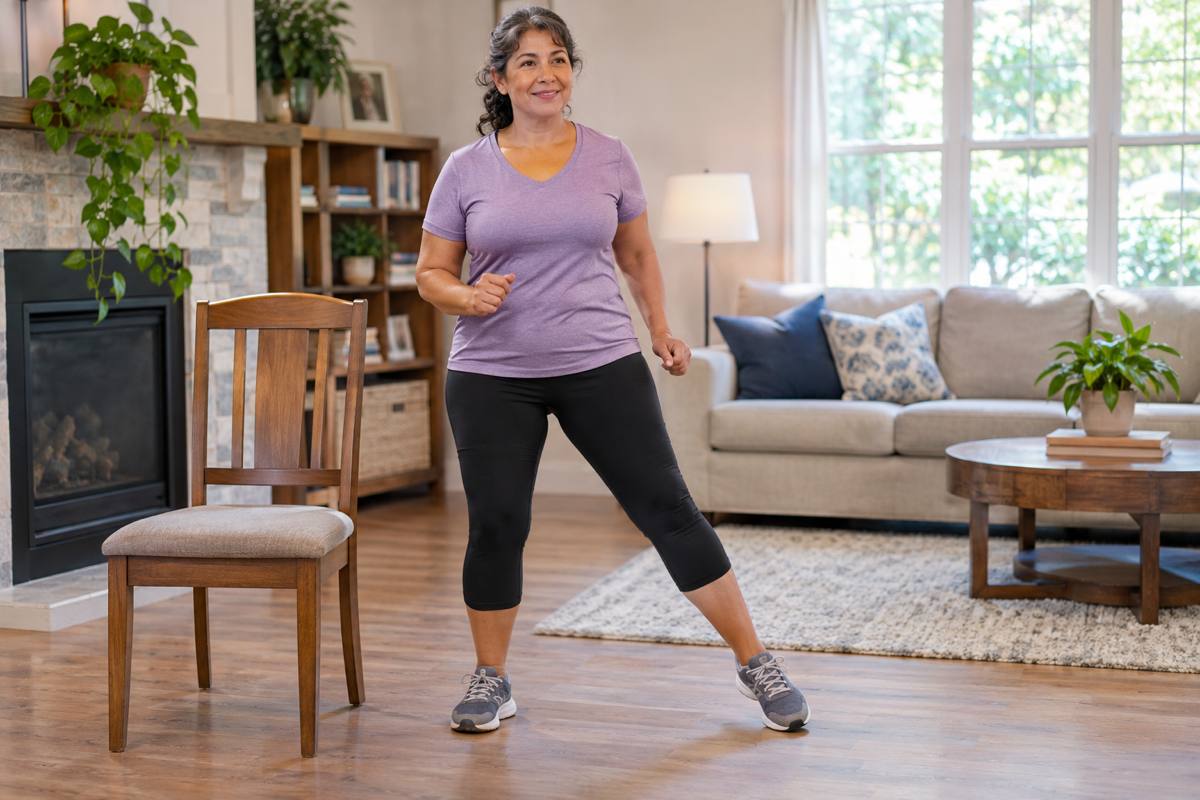
Use the clock as a guide, not a command. You may repeat a comfortable minute, reduce the range of motion, or pause. Keep your torso tall without forcing a rigid posture, let your shoulders stay relaxed, and place each foot quietly enough that you remain in control.
| Time | Movement | How to do it |
|---|---|---|
| 0:00–1:00 | Easy march | Walk in place with small steps. Let the arms move naturally or keep hands near the chair. |
| 1:00–2:00 | Step-touch | Step to one side and bring the other foot in; switch directions every step or every two steps. |
| 2:00–3:00 | Heel taps | Tap one heel forward, return to center, and alternate. Keep the supporting knee soft rather than locked. |
| 3:00–4:00 | Comfortable march | Return to marching. Increase the pace slightly only if breathing and balance remain comfortable. |
| 4:00–5:00 | Side steps | Take two or three small steps to one side, then return. Reduce this to step-touch if space is limited. |
| 5:00–6:00 | Low knee lifts | Alternate lifting one foot a few inches. The knee does not need to reach hip height. |
| 6:00–7:00 | Wide-and-narrow march | Take two slightly wider marching steps, then two normal-width steps. Avoid twisting the knees. |
| 7:00–8:00 | Purposeful march | Use your most comfortable sustained pace. Add a gentle arm swing if it helps rather than disrupts balance. |
| 8:00–9:00 | Step-touch or heel taps | Choose whichever movement felt steadier earlier and gradually reduce the pace. |
| 9:00–10:00 | Easy cool-down walk | Take smaller, slower steps. Let breathing settle before stopping or sitting down. |
A seated marching alternative
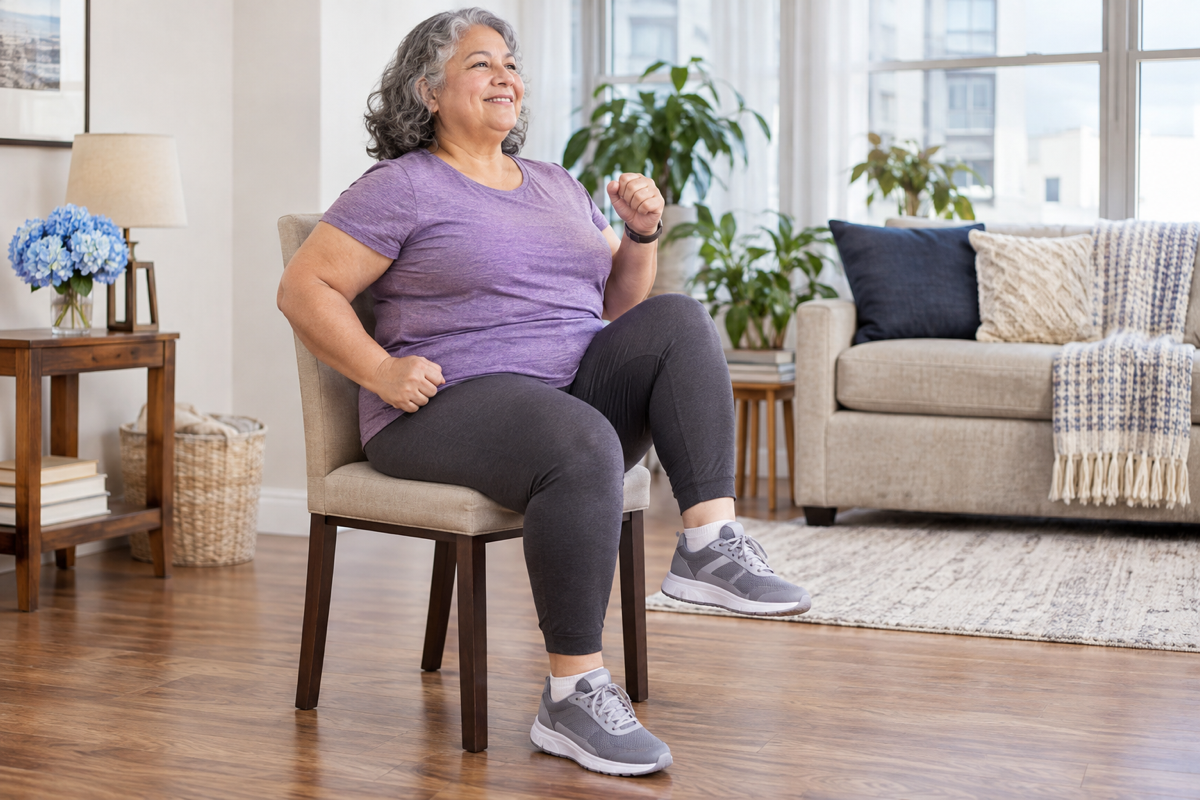
A seated session is not a failure or a lesser form of participation. It may be the more appropriate option when standing affects pain, fatigue, balance, or safety. Sit toward the front half of a stable chair with both feet on the floor and your chest comfortable—not forced upward. Keep the movement range small enough to stay controlled.
| Minutes | Seated option |
|---|---|
| 0–2 | Alternate heel lifts, then gently march one foot at a time. |
| 2–4 | Tap one foot slightly forward and return; alternate sides. |
| 4–6 | Continue seated marching and add an easy opposite-arm swing if coordinated movement feels comfortable. |
| 6–8 | Tap one foot a few inches to the side, return to center, and switch. |
| 8–10 | Return to smaller marches, then heel lifts as a cool-down. |
If lifting a foot is not comfortable, shift weight gently between the feet or alternate heel and toe lifts. Stop if you slide forward, lose control of posture, or develop concerning symptoms.
How to progress without making every session harder
Repeat the exact routine long enough to learn how you respond. Progress does not have to mean faster steps. You can add another day, add a second short session later in the day, or extend one comfortable portion by a minute. Change one variable at a time so you can tell what your body tolerates.
| Week | Simple schedule | Progression choice |
|---|---|---|
| 1 | 10 minutes on 3 nonconsecutive days | Learn the movements and identify a comfortable pace. |
| 2 | 10 minutes on 4 days | Repeat the routine; do not add speed unless it feels clearly manageable. |
| 3 | 10 minutes on 4–5 days | Optionally make one middle minute slightly more purposeful. |
| 4 | 10 minutes most days or two 10-minute sessions on selected days | Choose frequency or duration—not both at once. |
Another option is to alternate this workout with the site’s four-week beginner walking routine. If you are ready to build beyond walking, strength activity is also part of the U.S. adult activity guidelines; start with an appropriate plan rather than turning every walking session into a harder workout.
Does a 10-minute indoor walk help with weight loss?
It can contribute to a more active routine, but it does not guarantee weight loss. Body-weight change reflects eating patterns, total activity, sleep, medication, health conditions, genetics, environment, and other factors. The CDC notes that people vary considerably in how much activity they need for weight management. That is why this article does not provide a calorie-burn estimate: watches and exercise charts can be imprecise, and the number would not predict individual results.
Measure success first by behavior: Did you start? Did the room setup feel safe? Could you maintain control? Would this fit your schedule three or four times next week? Pair movement with satisfying meals rather than using exercise to compensate for eating. Our flexible plate guide offers a non-restrictive place to begin.
Common beginner mistakes—and useful fixes
- Starting too fast: make minute one deliberately easy and earn the option to increase pace later.
- Lifting the knees as high as possible: use a smaller range that lets you keep balance and control.
- Holding the breath: relax the jaw and shoulders and return to a pace where breathing feels manageable.
- Using furniture that moves: choose a sturdy chair or counter; never rely on a rolling chair.
- Trying to make up for a missed day: continue with the next planned session instead of doubling the workout.
- Treating pain as proof of effort: sharp, worsening, or unusual pain is a reason to stop and reassess—not a goal.
Frequently asked questions
Can I do this 10-minute workout every day?
Many people can tolerate gentle walking frequently, but daily activity is not automatically appropriate for everyone. Begin with a repeatable schedule, notice pain and recovery, and use professional guidance when a condition or injury changes what is safe.
Do I need to walk fast for it to count?
Any movement can be a meaningful step away from complete inactivity. Moderate-intensity activity is what counts toward the standard aerobic guideline, but beginners can start below that intensity and build gradually. Your effort—not somebody else’s speed—determines how hard the movement is for you.
Can I do it barefoot?
That depends on the floor, your balance, foot health, and professional recommendations. Supportive shoes may improve comfort and traction for many people. If you have diabetes-related foot concerns, neuropathy, or a recent foot injury, ask your care team about footwear and activity.
What if I live in an upstairs apartment?
Keep steps low and quiet, avoid jumping, and use heel taps, side steps, and seated marching. A rug can reduce sound only if it lies flat and does not create a trip hazard.
What should I do after the workout?
Walk slowly until breathing settles, drink according to thirst and your health needs, and notice how you feel later that day and the next morning. You do not need a special recovery product after a gentle 10-minute session.
Sources and further reading
- CDC — What Counts as Physical Activity for Adults
- CDC — Adult Activity: An Overview
- CDC — Benefits of Physical Activity
- NIDDK — Tips for Starting Physical Activity
- CDC — Physical Activity and Your Weight and Health
Explore more beginner-friendly options in the Movement hub.